Call us now :08045478879
 Send Inquiry
 Send Inquiry
Refractometer Erma Salinity
Price 1000 INR/ Piece
MOQ : 1 Piece
Refractometer Erma Salinity Specification
- Measuring Range
- 0-100 Salinity
- Display Type
- Analog Scale (Eyepiece)
- Specimen Size
- 2-3 Drops
- Response Time
- Instant
- Mounting Type
- Handheld
- Resolution
- 1
- Number of Specimens
- Single Sample
- Product Type
- Salinity
- Automation Grade
- Manual
- Temperature
- 10C to 30C
- Usage
- Measuring Equipment
- Features
- Portable, Easy To Use, No Power Required
- Application
- Industrial
- Accuracy
- 1.0
- Humidity
- Up to 85% RH (Non-Condensing)
- Machine Weight
- Approx. 230g
- Test Speed
- Manual (Instant)
- Control Mode
- Manual
- Body Material
- Metal with Rubber Grip
- Accessories
- Dropper, Calibration Screwdriver, Cleaning Cloth
- Length
- Approx. 200 mm
- Eyepiece Focus
- Adjustable
- Storage Case
- Included
- Prism Material
- Optical Glass
- Calibration
- Manual, Using Distilled Water
- Equipment Type
- Handheld Refractometer
Refractometer Erma Salinity Trade Information
- Minimum Order Quantity
- 1 Piece
- Supply Ability
- 1000 Pieces Per Month
- Delivery Time
- 7-10 Days
About Refractometer Erma Salinity
Erma Refractometer is a device used to measure the salinity of a liquid, such as seawater or brine. It works on the principle of measuring the refractive index of the liquid, which is directly proportional to its salinity.The refractometer consists of a prism that is in contact with the liquid being tested. The prism refracts the light passing through the liquid, and the amount of refraction is measured by a scale on the device. The salinity can then be determined from the scale readings.
The Erma Refractometer is specifically designed for measuring salinity in seawater. It can measure salinity levels from 0 to 100 ppt (parts per thousand), which covers the range of salinity found in most natural seawater environments.
Reliable Salinity Measurement for Multiple Applications
This refractometer delivers quick and accurate salinity readings for various solutions, such as seawater, brine, aquarium water, and food processing fluids. Its robust design ensures longevity and dependable performance even in demanding industrial environments. The analog scale display provides clear results instantly, enabling rapid decision-making and quality control.
User-Friendly Design & Portable Convenience
Designed for handheld use, the device is lightweight (approx. 230g) and streamlined with a non-slip rubber grip. Calibration and focusing are done manually, allowing adjustments for optimal clarity and precision. With no batteries or power needed, it is perfect for fieldwork and remote sampling. Organized accessories and a sturdy carry case guarantee easy storage and transport.
FAQ's of Refractometer Erma Salinity:
Q: How do I calibrate the Refractometer Erma Salinity, and what is needed?
A: Calibration is performed manually using distilled water and the provided calibration screwdriver. Simply place a few drops of distilled water on the prism, adjust the scale to zero using the screwdriver, and your device is ready for accurate measurements.Q: What types of solutions can I measure with this handheld refractometer?
A: This refractometer is ideal for measuring the salinity of seawater, brine solutions, aquariums, and samples found in food processing industries, supporting a wide range of professional and industrial applications.Q: Where can I use the Refractometer Erma Salinity?
A: It is suitable for fieldwork, laboratories, industrial sites, aquaculture farms, and food production facilities-anywhere reliable salinity measurement is required.Q: What is the process for obtaining a salinity reading with this equipment?
A: Apply 2-3 drops of your sample onto the optical prism, close the cover gently, look through the eyepiece, and read the salinity level instantly from the analog scale. No waiting time or power source is needed.Q: When should I recalibrate my refractometer?
A: Recalibration is recommended before initial use, after extended storage, or if you notice questionable readings during routine measurements. Periodic calibration ensures ongoing accuracy, especially in varying temperature or humidity conditions.Q: What are the benefits of using this refractometer compared to digital types?
A: This manual handheld refractometer offers instant results, doesn't require batteries, handles demanding environments well, and is simple to maintain. It's cost-effective for frequent salinity checks without digital complications.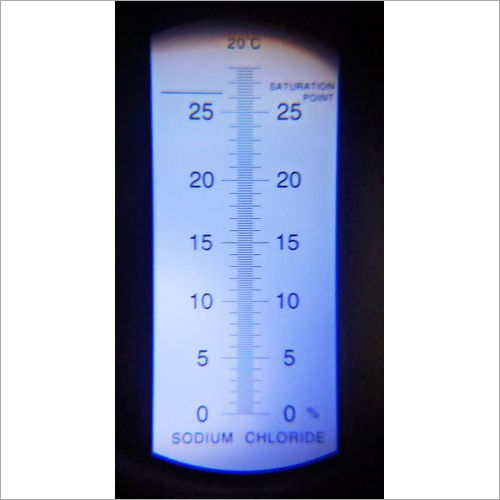
Tell us about your requirement

Price:
Quantity
Select Unit
- 50
- 100
- 200
- 250
- 500
- 1000+
Additional detail
Mobile number
Email


 Send Inquiry
Our Products
- PH Meter
- TDS Meter
- Pen Type Thermometer
- Moisture Meter
- ORP Meter
- Glass And Quartz Corvette
- Digital Hygrometer
- Infrared Thermometer
- Altimeter And Barometer
- Haemocytometer And Blood Counting Chamber Kit
- Digital Micrometer And Caliper
- Data Logger
- Countdown Timer
- Hardness Tester
- Turbidity Meter
- PH Electrode
- RefrectoMeter
- Euteck Ph Meter
- Tachometers
- Dissolved Oxygen Meter
- Hand Held Anemometer
- Metravi Digital Tachometer
- Hygrometer Gauge
- Tds Meter - Water Purity Tester
- Insize Micrometer
- Refecto Meter
- Aneroid Barometer
- Orp Electrode
- Hanna Equipment
- Refracto Meter
- Garmin Gps Handheld
- Digital Anemometers
- Thermometer
- Refracto Meters
- Gloss Meters
- Countdown Timer And Counter
- Distance Meter And Platinum Crucibles
- Glass And Quartz Cuvette
- Digital Thermometer
- Glass Cuvette
- Ph Tester
- Paper Moisture Meter
- Hydrogen meter
- Breathalyzer Tester
- Grain Moisture Meter
- Digital Vernier Calliper
- Digital Grain Moisture Meter


Plot No. E-121, Street No. 3/9, Hardev Nagar, Jharoda Mazra,Delhi - 110084, India

Mr Arvind Shukla
(Proprietor)
Mobile :08045478879
 Send Inquiry
 Send SMS
Developed and Managed by Infocom Network Private Limited.
